












15 Puzzle Sliding
15 Puzzle Sliding Definition & Rules
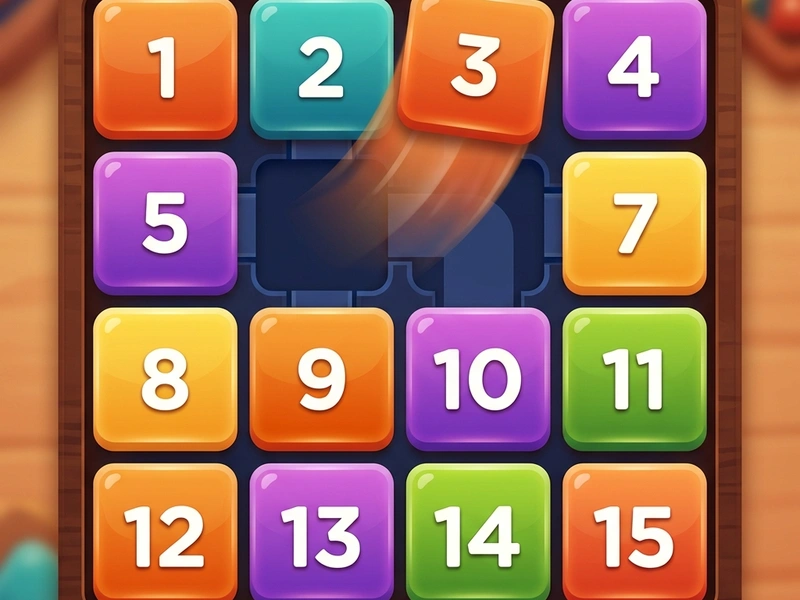
Challenge your spatial planning and numerical ordering skills with the classic 15 Puzzle Sliding. This board game features a 4x4 grid containing 15 numbered square tiles and one empty space. Your objective is to arrange the tiles in ascending order from 1 to 15, starting from the top-left corner and ending with the empty slot in the bottom-right. This implementation of the traditional 15 Puzzle requires you to coordinate your moves to shuffle numbers without locking them in the wrong positions.
History of the Classic Sliding Tile Game
The 15 Puzzle is one of the oldest and most famous sliding puzzles in the world. It was invented in 1874 by Noyes Palmer Chapman, a postmaster in Canastota, New York. The puzzle set off a massive craze in the United States and Europe in 1880, similar to the Rubik's Cube craze a century later. It is a famous mathematical puzzle that demonstrates group theory and parity. This online Scratch edition replicates the wooden layout and mechanical tile slide in a responsive format.
Rules & Solvability
The grid consists of 16 slots. Fifteen are occupied by numbered square blocks, and one remains empty. You slide adjacent blocks into the empty space. You cannot pick up tiles; you can only slide them horizontally or vertically. The puzzle is solved when the blocks are ordered 1 to 15 from left to right, top to bottom. Note that not all random starting scrambles are solvable. Specifically, half of all random starting states are mathematically impossible to solve. This simulator guarantees that every scramble generated is 100% solvable.
Pro Strategies to Solve the 15 Puzzle
- Solve Row by Row: Focus on solving the first row first (1, 2, 3, 4). Once they are placed, do not move them again. Then solve the second row (5, 6, 7, 8).
- Solving Corners (3 and 4): Place the "3" in the "4" slot, then place the "4" directly underneath it. Sliding the "3" left will pull the "4" into its correct place.
- Solve the Remaining 2x4 Area: Once the top two rows are solved, you only have rows 3 and 4 to manage. Work from left to right, placing 9 and 13 first.
- Keep the Empty Space Flexible: Do not trap the empty space in a corner. Keep it in the middle rows to rotate numbers smoothly.
Controls Guide
- Click / Tap on Tile: Slide Tile (Slides the clicked block into the adjacent empty space.)
- Arrow Keys: Slide Directional (Slides the block adjacent to the empty space into the slot.)
- Reset Button: Shuffle Grid (Randomly shuffles the tiles into a guaranteed solvable layout.)
Key Game Highlights
- Beautiful polished wooden tile graphics.
- Tracks the number of moves and elapsed time to measure your progress.
- Smooth, responsive sliding animations with clean collision detection.
- 100% solvable scrambles, preventing frustrating dead-ends.
💬 0 Comments
Leave a Comment