







Six-Sided Streets
Welcome to our deep dive into Six-Sided Streets, an engaging and highly relaxing tile-laying puzzle game that challenges your strategic planning and spatial awareness. Originally developed in just one month for the "Eggplant Podcast Community Game Jam" (under the theme "HEXES"), this brilliant title by Chris Klimowski has captured the hearts of puzzle enthusiasts and strategy fans alike. If you are looking for an addictive city building game that runs beautifully in your browser without requiring any downloads, this is an experience you simply cannot miss.
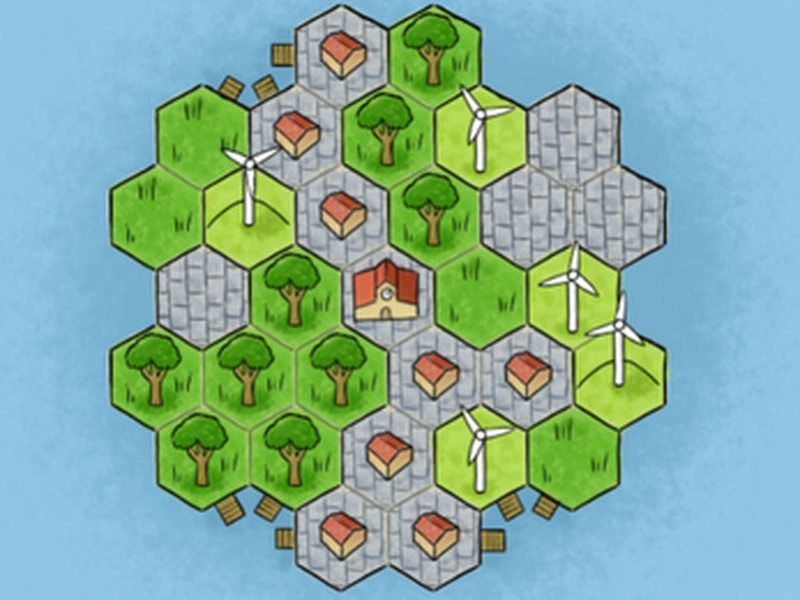
At its core, the game tasks players with building a small town on a hexagonal grid. Drawing clear design inspirations from acclaimed board games such as My City by Reiner Knizia, Tiny Islands by David King, and Cascadia by Randy Flynn, this HTML5 browser-based game delivers a rich, replayable experience. Let us explore the fundamental mechanics, scoring rules, and strategic depth that make this puzzle game a standout high-score challenge.
Hexagonal Grid Building
The foundation of this puzzle experience revolves heavily around the concept of hexagonal grid building. Rather than relying on traditional square tiles, the environment is completely composed of hexes, which organically shapes how your small town develops over time. This design choice inherently provides more complex adjacency possibilities.
- Build a pleasant small town entirely on a distinct hexagonal grid layout.
- Experience a relaxing yet challenging spatial puzzle atmosphere.
- Utilize the natural six-sided shape to create organic-looking maps.
- Plan your town layout carefully to maximize potential scoring adjacencies.
- Navigate the game effortlessly using the on-screen buttons, your mouse wheel, or specific Directional keys for perfect orientation.
Because the grid relies on hexes, every single placement feels impactful. You are constantly evaluating the expanding edges of your town, ensuring that every newly added section fits seamlessly into the overarching layout. The game masterfully blends the relaxing nature of a town builder with the challenging elements of an optimization puzzle.
Trihex Tile Placement
One of the most defining characteristics of the game is its unique approach to tile placement. Instead of placing single hexes one by one, you place pieces known as "trihexes" – which are shapes composed of exactly three hexes combined. This adds a significant layer of depth to your town-planning strategy.
- Place distinctive pieces consisting of three hexes at a time (trihexes).
- Rotate your next piece using the A and D keys, your mouse wheel, or the Directional keys to find the perfect fit.
- Click to seamlessly place the trihex pieces onto your ever-growing board.
- Manage the random set of pieces that the game generates for each session.
- Adapt to the shapes provided to avoid trapping yourself in dead ends.
The trihex mechanism forces players to think multiple steps ahead. Because you cannot simply slot a single hex into a tight gap, you must constantly maintain open areas that can accommodate these larger, three-hex pieces. The controls are highly accessible, allowing you to use Directional keys to rotate and manipulate these shapes with ease before committing to a placement.
Terrain Type Scoring
Your ultimate objective is a high-score challenge, and understanding the scoring system is absolutely crucial. The game features various terrain types, and each terrain type scores differently based on its unique rules. This transforms a simple town builder into a complex puzzle of spatial optimization.
- Maximize your score by understanding how each specific terrain type functions.
- Balance the placement of different terrains to avoid conflicting scoring rules.
- Adapt to a new random map layout generated each time you play.
- Capitalize on the high replayability offered by the varied terrain distributions.
- Focus on achieving a personal best in this endless high-score challenge.
Every time you start a new session, the game generates a new random map and a fresh set of pieces. This incredible replayability ensures that no two towns are ever exactly the same. You must constantly re-evaluate your strategy based on the specific terrain types available and the layout of the initial map, striving to beat your previous high score through clever terrain management.
Harborfront Connections
A key scoring mechanic involves the game's road networks and water features. Specifically, the interactions between brick roads and harborfronts provide a major avenue for accumulating points. Understanding this connection is vital for any player aiming for a top-tier score.
- Construct extensive brick roads throughout your developing small town.
- Connect these brick roads directly to harborfronts to score massive points.
- Carefully route your infrastructure to ensure continuous, unbroken connections.
- Avoid cutting off your brick roads with incompatible terrain types.
- Utilize the rotation controls, like the Directional keys, to align your roads perfectly.
By focusing on linking your brick roads to harborfronts, you can create highly lucrative scoring engines. This requires meticulous planning, as you must snake your roads across the hexagonal grid without running into obstacles. Successfully completing a long, winding brick road that terminates at a harborfront is one of the most satisfying and rewarding aspects of the entire puzzle.
Wind Turbine Placement
While some terrain types reward connection and grouping, others require careful separation. The wind turbines represent a fascinating spatial challenge, as their scoring rules dictate a need for distance and careful positioning within your town.
- Incorporate wind turbines into your town to generate essential points.
- Ensure you space them out, as placing wind turbines too close together can deduct points.
- Analyze the grid to find optimal, isolated spots for your green energy infrastructure.
- Balance the need for wind turbines with the space required for your parks and brick roads.
- Avoid clustering them, turning a potential scoring boon into a detrimental penalty.
The wind turbine mechanic perfectly illustrates the game's "relaxing yet challenging" nature. It introduces a negative constraint—a penalty for poor placement—that forces you to be mindful of your entire board. You cannot simply dump all your wind turbines in one corner; you must thoughtfully distribute them across your hexagonal grid to maximize their value while avoiding any point deductions.
In conclusion, this brilliant creation by Chris Klimowski offers an exceptional puzzle experience directly in your browser. With its deep inspirations from tabletop classics, endless replayability driven by random maps, and intricate scoring mechanics involving trihexes, brick roads, harborfronts, parks, and wind turbines, it stands as a premier high-score challenge. Whether you are using your mouse or the Directional keys to carefully lay out your next town, this game promises hours of strategic, tile-laying enjoyment.
💬 0 Comments
Leave a Comment